
Under-Eye Fat Transfer

Under-eye fat transfer uses a small amount of your own fat to restore selected volume beneath the eyes and soften the transition into the cheek. Because the eyelid area is delicate, treatment is conservative and intended for true hollowing rather than every type of dark circle or under-eye bag.

Under-Eye Fat Transfer

/ Benefits

Benefits of Under-Eye Fat Transfer

  • Uses your own tissue: No synthetic filler is required for the transferred volume.
  • Can soften tear-trough hollowing: Appropriate graft placement can improve a skeletal or shadowed lid-cheek transition.
  • Potentially long-lasting: Fat that establishes a blood supply can remain for years and behaves like fat elsewhere in the body.

/ At a glance

Under-Eye Fat Transfer at a glance

Surgery duration1 - 1.5 hours
Result lastsLong-term for surviving grafted fat
Follow-upIncluded
Hospital stayDay case
Drive5 - 7 days
Shower1 - 2 days
Sport2 - 3 weeks
Sexual activity1 - 2 weeks

/ Patient voice

What patients say.

All reviews
From the first consultation, I felt listened to rather than sold to. Everything was explained clearly, including what surgery could and couldn’t achieve. The result feels completely natural — I still look like myself, just more rested.
DIANAGOOGLE JAN 12, 2026
I was nervous about having surgery, but the whole process felt calm and very well organised. The team were reassuring without ever being dismissive, and the follow-up care was excellent.
HELENEGOOGLE DEC 10, 2025
What mattered most to me was that the result didn’t look ‘done’. The change is subtle, balanced and exactly what I hoped for.
MAXIMEGOOGLE NOV 24, 2025

/ How it works

How does Under-Eye Fat Transfer work

  • Harvests a small amount of fat: Fat is usually taken from the abdomen, flank or thigh through a small cannula.
  • Processes the graft: The harvested fat is prepared to isolate suitable small-volume graft material.
  • Places tiny amounts precisely: Micro-aliquots are layered beneath the eye and across the lid-cheek junction.
  • Allows for partial resorption: Some transferred fat does not survive, so conservative planning accounts for biological graft take.

/ Patient journey

Patient journey

01Step

Consultation

1. Understanding Your Goals

  • Your priorities: The consultation starts with what you would like to change, what matters most to you and what you hope surgery will achieve.

2. Clinical Assessment

  • Clinical assessment: Dr Mercer assesses anatomy, tissue quality, asymmetry, scars and any factors that may affect the operation or healing.

3. Options, Limits & Planning

  • Options and limits: Suitable surgical options, likely scars, trade-offs and realistic outcomes are discussed rather than assuming that surgery is the right answer.
  • Planning: If you choose to proceed, clinical photography, measurements and a personalised operative plan are completed before a surgery date is confirmed.
02Step

Planning

Before surgery

  • Assessment: The surgeon distinguishes hollowing from true bags, pigmentation, oedema and skin laxity.
  • Donor area: A suitable small fat-harvest area is selected.
  • Preparation: Follow nicotine, medication and fasting instructions and arrange transport.
03Step

Surgery day

Anaesthesia

  • Anaesthesia: The procedure may be performed under general anaesthesia or local anaesthesia with sedation, especially when combined with eyelid surgery.

Fat grafting

  • Harvest: A small volume of fat is removed through a tiny access point.
  • Preparation: Fat is processed for fine grafting.
  • Injection: Very small parcels are placed in controlled planes beneath the lower eyelid and upper cheek.
  • Assessment: Symmetry is checked repeatedly; deliberate overfilling is avoided in this delicate region.
04Step

Recovery

Week 1

  • Appearance: Puffiness and bruising can make the area look temporarily overfilled.

Weeks 2–3

  • Social recovery: Most visible bruising improves, but residual swelling may remain.

1–3 months

  • Graft settling: Swelling falls and the surviving fat begins to define the stable contour.

3–6 months

  • Result: The longer-term graft take can be assessed more reliably.
05Step

Aftercare

First 2 weeks

  • Swelling: Use cool compresses if advised and expect temporary puffiness.
  • Pressure: Avoid massage or pressure on the grafted area unless specifically instructed.

Weeks 3–6

  • Activity: Resume exercise progressively.
  • Assessment: Early volume is not the final result because swelling falls and some graft resorption occurs.
06Step

Follow-up

Early review

  • What happens: The team checks wounds, swelling, comfort and any dressings during the first postoperative period.

1–2 weeks

  • What happens: Incisions and early healing are reviewed; sutures or dressings are removed when appropriate and activity guidance is updated.

6 weeks

  • What happens: Dr Mercer reviews recovery, scars and return to exercise, and checks that healing is progressing as expected.

3–6 months

  • What happens: Progress photographs may be taken as swelling settles and scars continue to mature.

Around 1 year

  • What happens: A longer-term review can be used to assess the mature result once tissues and scars have fully settled.

/ Results

View Before & After Results

Explore real patient outcomes and see the considered results achieved across our procedures.

Result image — to supply
View photo gallery

Contraindications

When Surgery May Not Be Suitable

  • Uncontrolled medical conditions: Elective surgery may need to be postponed until significant heart, lung, clotting, metabolic or other medical problems are appropriately managed.
  • Nicotine use: Smoking, vaping and nicotine products can materially increase wound-healing and tissue-compromise risks; a nicotine-free period may be required.
  • Pregnancy or breastfeeding: Elective aesthetic surgery is normally deferred until pregnancy and breastfeeding are complete and the body has stabilised.
  • Unrealistic expectations: Surgery can change anatomy and proportion, but it cannot create perfect symmetry or guarantee a particular emotional or social outcome.
  • Prominent lower-eyelid bags without meaningful hollowing: Fat transfer alone can worsen fullness; lower blepharoplasty may be a better structural treatment.

Risks and side effects

Risks & Possible Complications

All surgery carries risk. Your individual risk profile is discussed during consultation and again as part of the consent process.

  • Swelling and bruising: Under-eye swelling can be marked during the first one to two weeks.
  • Irregularity or asymmetry: Small lumps, uneven graft take or side-to-side differences can occur.
  • Under- or over-correction: Some fat resorbs, while excessive surviving volume can create fullness.
  • Fat necrosis or cysts: Small firm areas or oil cysts are possible.
  • Vascular injury: Fat injection around the face carries rare but serious vascular risks, including visual complications, which require meticulous technique and informed consent.
  • Donor-site bruising: The small harvest area can be sore or bruised.

/ Price

Under-Eye Fat Transfer pricing

Under-Eye Fat Transfer £4,800

Lower Blepharoplasty + Fat Grafting £7,800

Request a consultation Finance available
Years in practice
18
Primary specialty
Plastic surgeon
Consulting at
London, Private Clinic

/ The surgeon — Dr Adrian James Mercer

A considered approach to plastic surgery

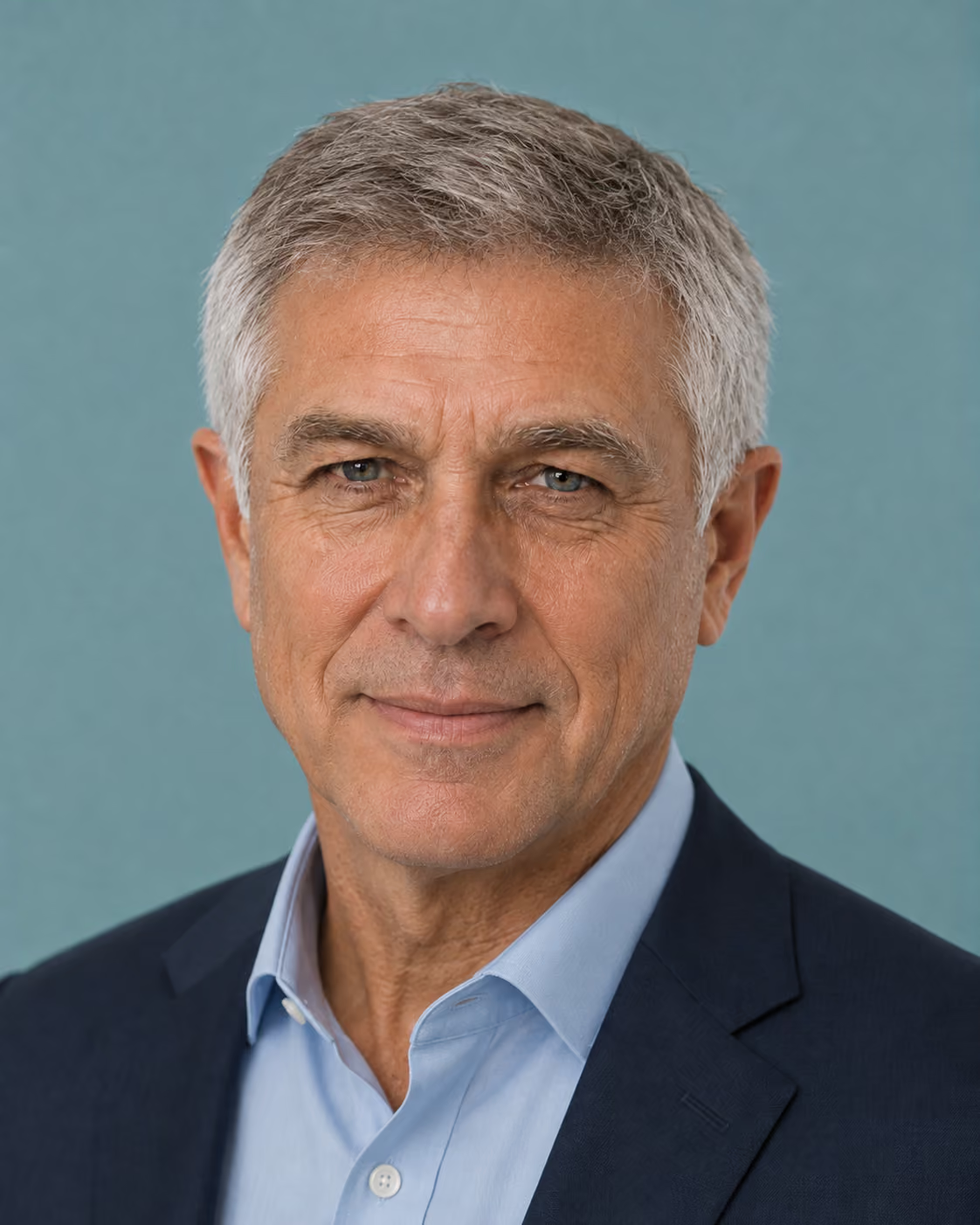
Dr Adrian Mercer is a Consultant Plastic, Reconstructive & Aesthetic Surgeon based in London. His practice is centred on considered decision-making, precise surgical planning and natural, proportionate outcomes, with continuity of care from consultation through recovery.

/ Qualifications

  • MBBS — Bachelor of Medicine, Bachelor of Surgery
  • BSc (Hons) — Medical Sciences
  • MRCS — Member of the Royal College of Surgeons
  • FRCS (Plast) — Fellowship of the Royal College of Surgeons in Plastic Surgery
  • Specialist training in Plastic, Reconstructive & Aesthetic Surgery

/ Memberships

  • GMC Specialist Register in Plastic Surgery
  • British Association of Plastic, Reconstructive and Aesthetic Surgeons (BAPRAS)
  • British Association of Aesthetic Plastic Surgeons (BAAPS)
  • Fellow of the Royal College of Surgeons — FRCS (Plast)

/ FAQs

Frequently asked questions

How much of the transferred fat survives?
Survival varies by patient and technique. The stable result is judged only after swelling resolves and the graft has had several months to establish.
Can fat transfer replace lower blepharoplasty?
Not when prominent eye bags or significant eyelid laxity are the main problem. It is most useful for carefully selected hollowing and volume loss.
Can the result change with my weight?
Yes. Surviving fat behaves like fat elsewhere in the body and can enlarge or shrink with significant weight change.
How much does under-eye fat transfer cost?
Indicative standalone pricing starts at £4,800; combined lower blepharoplasty with fat grafting is typically £7,800.

/ Request a consultation

Visit or contact the clinic

Use this area for a short, practical introduction to the clinic and the easiest ways to get in touch.

WhatsApp
32000000000
Address
123 Clinic Street, London Show on map ↗
Opening hours
Monday 09:00–18:00 Tuesday 09:00–18:00 Wednesday 09:00–18:00 Thursday 09:00–18:00 Friday 09:00–18:00 Saturday 09:00–18:00 Sunday Closed
Parking
Free parking available

Contact Us

We will get back to you within 24 hours.

Email or phone

Please provide at least one of these.

Do not include sensitive personally identifiable information (PII) or protected health information (PHI) in your message. This form is for general enquiries only.